
Why does this matter?
The quality of manufacturing data directly affects quotation speed, ambiguity risk and inspection planning. File format matters, but so do revision status, critical dimensions and clear manufacturing intent.
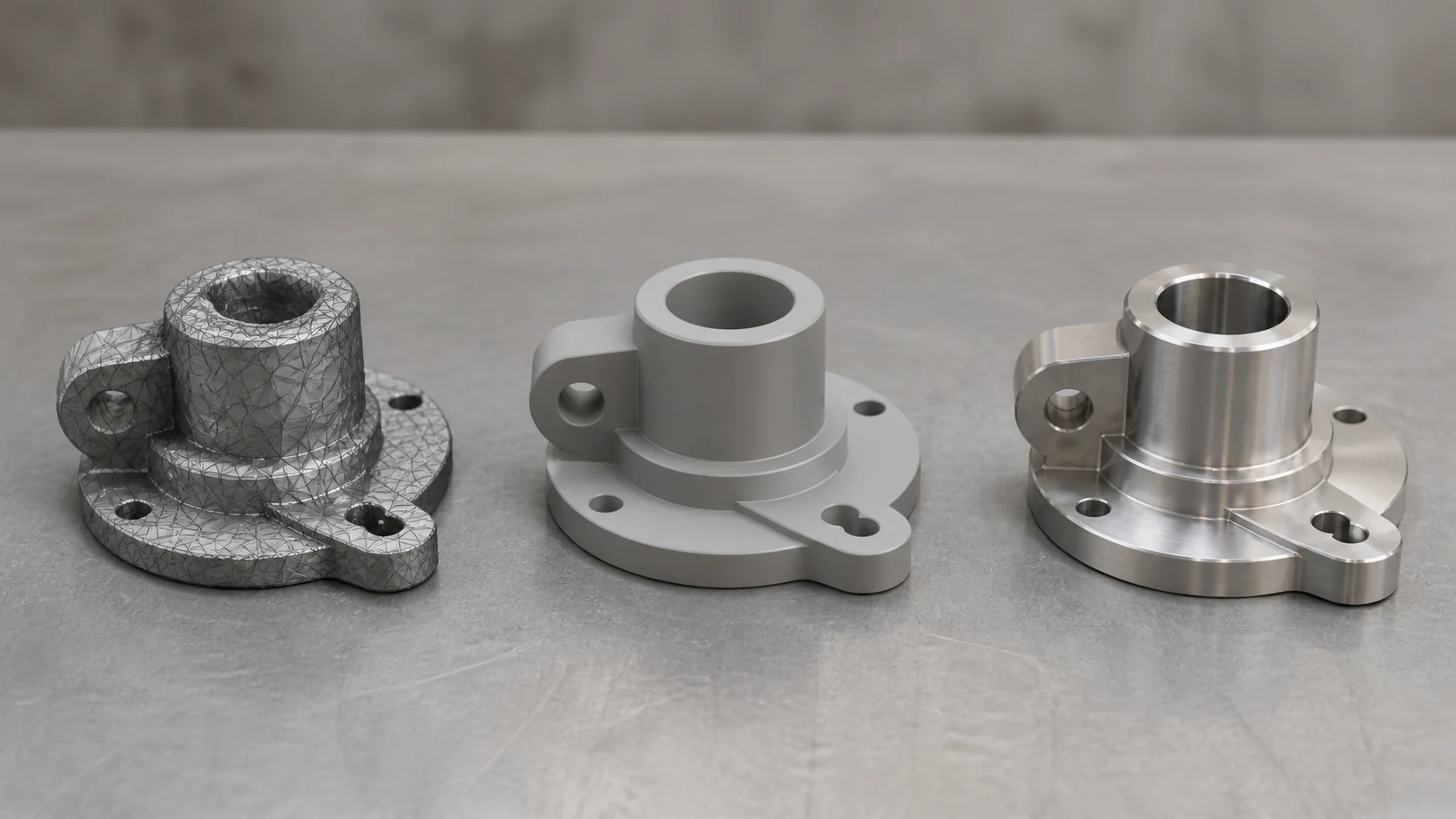
What should you check?
- 3D CAD/mesh data, revision status and required output format
- Critical dimensions, tolerances and required accuracy level
- Part function, mating components and functional relationships
- Geometry, access, tool approach and critical form features
A practical evaluation sequence
First decide whether scanning is actually needed. When dense free-form surface data is useful, 3D scanning can be coordinated through specialist solution partners; critical functional dimensions should still be checked against datums, conventional measurements and the manufacturing objective.
Common mistakes
- Assuming a mesh is automatically a production-ready parametric CAD model
- Treating scanner resolution and finished-part tolerance as the same thing
- Ignoring how reflective, dark, inaccessible or worn surfaces can affect captured data
3D scanning is a data-capture method; manufacturing decisions require the mesh, function, critical dimensions and CAD reconstruction to be considered together.
What should you send for evaluation?
- 3D CAD/mesh data, revision status and required output format
- Part function, mating components and functional relationships
- Critical dimensions, tolerances and required accuracy level
- Technical drawing, datums, dimensions and available measurement results
Where can Gizmak help?
If a physical sample needs to be digitised, we can coordinate 3D scanning through specialist solution partners. The resulting data can then feed into reverse engineering, manufacturable CAD, CNC production and inspection.
Reverse engineering